


Defining human agency
Human agency is the feeling that we are free to choose and that the choices we make align with our sense of self. We’ve made a deliberate choice and we endorse it. We don’t tend to think about agency. We feel it as a “background buzz of control”1. A positive sense that we can shape how our lives will be.
Sometimes it’s easier to notice when we lose agency. Most of us have experienced feelings of helplessness, the unsettling sense that life is happening to us and we are powerless to change things. Loss of agency negatively effects our health and wellbeing. It also impacts our capacity to hope because when we lose faith in our agency to influence our circumstances, we also lose hope that things can change for the better. Whether or not humans have agency matters.
We are our choices
Over the millennia and across the globe, philosophers, psychologists and lawyers have made the case for human agency, but the greatest manifesto of all is You Choose,2 a picture book aimed at toddlers. The premise of the book is simple: we can choose the life we want.
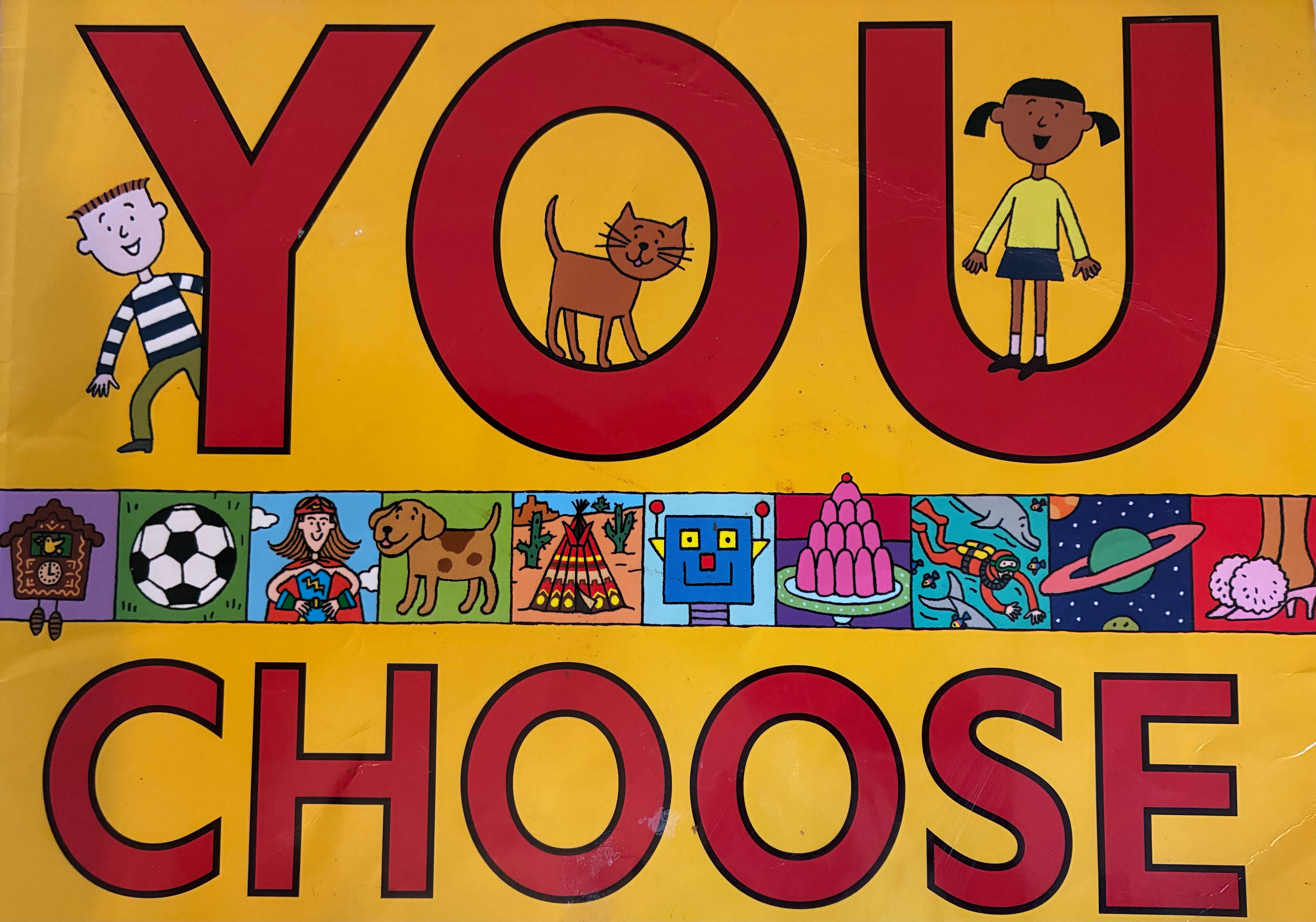
First, kids choose where they want to live - the mountains, a sprawling metropolis, perhaps the seaside? Then they decide the type of house they want -a spaceship, a mushroom or maybe a castle? Next comes interior design. I’ve learnt disco balls are essential, chairs and tables not so much. Each page offers a dazzling array of options for all essential life choices: friends, pets, careers, hobbies, outfits and (of course) food.
The book encourages kids to think big and puts zero limitations on the life they imagine for themselves. I’ve read the book hundreds of times with countless children and I have yet to come across a child who questions the premise of the book: they have agency.
As we get older, we learn life isn’t a picture book. We discover that our choices are constrained by our circumstances and that even our best-laid plans can be sideswiped by chance. We also learn that some of us have more freedom to choose than others. The choices available to us depend on who we love, how we identify, where we’re born, the colour of our skin, our mental and physical health, our bank balance and numerous other factors that in a kinder, fairer world wouldn’t come into play.
Though we may become more jaded, most of us hold on to the belief that our choices matter. Our choices transform life from a series of random events to a story that has meaning and purpose - the truth of who we are told through the choices we make along the way.
You Choose reminds us that agency - the ability to decide what we think, feel and do - is a fundamental to the human experience. When we have agency, we flourish. When we don’t, we suffer.
Do you have agency?
There’s been a surge in research on human agency over recent years. Whilst there’s no standard test to evaluate levels of agency, across the many questionnaires developed by academics,3 common themes have emerged.
Someone who has a strong sense of agency is likely to agree with statements like these:
I feel free to express my ideas and opinions
My actions are motivated by my values and interests
I decide how to live my life
I feel responsible for my behaviour and the consequences of my actions
Conversely, someone with a low sense of agency will tend to agree with statements like these:
My decisions are influenced by what other people want me to do
I find it difficult to know what I want
I often feel helpless in dealing with life’s problems
Sometimes I feel I am being pushed around by life
If you find yourself agreeing with the first set of statement then you already have a strong sense of agency. Go find yourself another substack.4 If the second set of statements resonate, don’t worry. There’s lots you can do to nurture your sense of agency. This Substack explains how to go about it.
Moore JW. What Is the Sense of Agency and Why Does it Matter? Front Psychol. 2016 Aug 29;7:1272. doi: 10.3389/fpsyg.2016.01272. PMID: 27621713; PMCID: PMC5002400.
Sharratt, N. & Goodhart, P. (2003). You Choose. Picture Corgi Books.
For a detailed explanation of the different questionnaires developed to measure agency see Constructing general human agency indicators (GHAIs) and a general personal agency scale (GPAS). D’Italia, M.J. & Okulicz‑Kozaryn, A. (2024). Social Indicators Research. 176, 337-411.
Not so fast… in future posts I’ll explore a phenomenon known as Agency Delusion. I’ll also encourage you to think about agency inequality, privilege and allyship.